Showing posts with label inflammation. Show all posts

Monday, June 13, 2011

Alcohol intake increases LDL cholesterol, in some people

Occasionally I get emails from people experiencing odd fluctuations in health markers, and trying to figure out what is causing those fluctuations. Spikes in LDL cholesterol without any change in diet seem to be a common occurrence, especially in men.

LDL cholesterol is a reflection of many things. It is one of the least useful measures in standard lipid profiles, as a predictor of future health problems. Nevertheless, if one’s diet is not changing, whether it is high or low in fat, significant fluctuations in LDL cholesterol may signal a change in inflammatory status. Generally speaking, the more systemic inflammation, the higher is the measured LDL cholesterol.

Corella and colleagues (2001) looked into alcohol consumption and its effect on LDL cholesterol, as part of the Framingham Offspring Study. They split the data into three genotypes, which are allele combinations. Alleles are genes variations; that is, they are variations in the sections of DNA that have been identified as coding for observable traits. The table below summarizes what they have found. Take a look at the last two columns on the right.
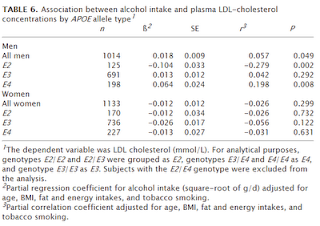

As you can see, for men with the E2 genotype, alcohol consumption significantly decreases LDL cholesterol. For men with the E4 genotype, alcohol consumption significantly increases LDL cholesterol. No significant effects were observed in women. The figure below illustrates the magnitude of the effects observed in men.


On average, alcohol consumption was moderate, around 15 g per day, and did not vary significantly based on genotype. This is important. Otherwise one could argue that a particular genotype predisposed individuals to drink more, which would be a major confounder in this study. Other confounders were also ruled out through multivariate controls - e.g., fat and calorie intake, and smoking.

Alcohol consumption in moderation seems, on average, to be beneficial. But for some individuals, particularly men with a certain genotype, it may be advisable to completely abstain from alcohol consumption. Who are those folks? They are the ones for whom LDL cholesterol goes up significantly following moderate alcohol consumption.

Monday, September 6, 2010

Low omega-6 to omega-3 ratio: Grain-fed meats or industrial vegetable oils?

Just a little note on the use of language. Clearly there is no such a thing as grain-fed or grass-fed beef, because one does not feed beef anything. One feeds cattle grain or grass, and then the resulting beef is said to be “grain-fed” or “grass-fed”. It is a manner of speaking that facilitates discourse, which is why it is used here.

To compensate for this digression, let me show you a graph, which pretty much summarizes the "punch line" of this post. The graph below shows the omega-6 fat contents of 1 lb (454 g) of grain-fed beef and 1 tablespoon (roughly 14 g) of a typical industrial vegetable oil (safflower oil). As you can see, there is a lot more omega-6 in the much smaller amount of industrial vegetable oil. A gram-for-gram comparison would practically make the beef content bar disappear.


It has been estimated that our Paleolithic ancestors consumed a diet with an omega-6 to omega-3 ratio of about 1. While other estimates exist, the general consensus seems to be that that ratio was not much greater than 5. Western diets, in contrast, typically have omega-6 to omega-3 ratios of between 15 and 40. In some cases, the ratio is even higher.

Omega-6 fats are essential fats, meaning that they must be part of one’s diet. Fats make up about 60 percent of our brain. About 20 percent is made up of omega-6 and omega-3 fats. The primary omega-6 fat found in our brain is arachidonic acid, which is either synthesized by our body based on linoleic acid from plant foods or obtained directly from animal foods such as meat and eggs. The predominant omega-3 fat found in our brain is docosahexaenoic acid (DHA), of which certain types of fish and algae are rich sources.

Inflammation is an important process in the human body, without which wounds would never heal. Incidentally, muscle gain would not occur without inflammation either. Strength training causes muscle damage and inflammation, after which recovery leads to muscle gain. Omega-6 fats play an important role in inflammation. Generally, they are pro-inflammatory.

Too much inflammation, particularly in a chronic fashion, is believed to be very detrimental to our health. A very high omega-6 to omega-3 ratio seems to cause excessive and chronic inflammation. The reason is that omega-3 fats are generally anti-inflammatory, counteracting the pro-inflammatory action of omega-6 fats. Over time, a very high omega-6 to omega-3 ratio is believed to cause a number of Western diseases. Among them are cardiovascular complications, cancer, and various autoimmune diseases.

So, should you worry about too much omega-6 from grain-fed meats?

If you think that the answer is “yes”, consider this. Apparently the (arguably) longest-living group in the world, the non-Westernized Okinawans, consume plenty of pork. Pork is a staple of their traditional diet. It is true that the average cut will have an omega-6 to omega-3 ratio of more than 7, which is not very favorable. Pork in general, whether grain-fed or not, is relatively high in omega-6 fats. As a side note, pork is not a good source of linoleic acid (found in plants), even though it is a rich source of arachidonic acid, the omega-6 fat synthesized from linoleic acid by various animals.

It is difficult to estimate the exact amounts of omega-6 and omega-3 fats from grain-fed cuts of meat; different sources provide different estimates. Here are some reasonable estimates based on various sources, including Nutritiondata.com. A typical 100 g portion of grain-fed pork should contain about 690 mg of omega-6 fats, and 120 mg of omega-3 fats. A typical 100 g portion of grain-fed beef should have about 234 mg of omega-6 fats, and 12 mg of omega-3 fats. It does not take that much omega-3 to counterbalance the omega-6 obtained from grain-fed pork or beef, even if one eats a lot of them. Two softgels of fish oil will normally contain about 720 mg of omega-3 fats (they will also come with 280 mg of omega-6 fats). Three sardines will have over 2 g of omega-3 fats, and less than 200 mg of omega-6 fats.

Industrial vegetable oils (made from, e.g., safflower seeds, soybean, and sunflower seeds) are very, very rich sources of omega-6 fats, in the form of linoleic acid. There is a lot more omega-6 in them than in grain-fed meats. One tablespoon of safflower oil contains over 10 g of omega-6 fats, in the form of linoleic acid, and virtually zero omega-3 fats. About 2 kg (4.4 lbs) of grain-fed pork, and 5 kg (11 lbs) of grain-fed beef will give you that much omega-6; but they will also come with omega-3.

How much fish oil does one need to neutralize 10 g of pure omega-6 fats? A lot! And there is a problem. Excessive fish oil consumption may be toxic to the liver.

If you cook with industrial vegetable oils rich in linoleic acid (this excludes olive and coconut oils), or eat out a lot in restaurants that use them (the vast majority), you will probably be consuming significantly more than 10 g of omega-6 fats per day. The likely negative health effects of eating grain-fed meats pales in comparison with the likely negative health effects of this much omega-6 fats from industrial vegetable oils.

You should reduce as much as possible your consumption of industrial vegetable oils rich in linoleic acid, as well as other products that use them (e.g., margarine). Keep in mind that industrial vegetable oils are in many, many industrialized foods; even canned sardines, if they are canned with soybean oil.

It is also advisable to couple this with moderate consumption of fish rich in omega-3, such as sardines and salmon. (See this post for a sardine recipe.) Taking large doses of fish oil every day may not be such a good idea.

Should you also consume only grass-fed meat? Do it if you can. But, if you cannot, maybe you shouldn’t worry too much about it. This also applies to eggs, dairy, and other animal products.

References:

Elliott, W.H., & Elliott, D.C. (2009). Biochemistry and molecular biology. New York: NY: Oxford University Press.

Ramsden, C.E., Faurot, K.R., Carrera-Bastos, P., Cordain, L., De Lorgeril, M., & Sperling (2009). Dietary fat quality and coronary heart disease prevention: A unified theory based on evolutionary, historical, global, and modern perspectives. Current Treatment Options in Cardiovascular Medicine, 11(4), 289-301.

Schmidt, M.A. (1997). Smart fats: How dietary fats and oils affect mental, physical and emotional intelligence. Berkeley, CA: North Atlantic Books.

Wednesday, March 3, 2010

Adiponectin and tumor necrosis factor-alpha levels after a high saturated fat meal

This is one of those interesting studies where the authors start with some pre-conceived assumptions and end up concluding something else, some way toward the opposite of what they assumed.

My final interpretation of the study results is a bit different though. It suggests that the results are actually the opposite of what the authors originally assumed.

The authors of the study (Poppitt et al., 2008; full reference at the end of this post) start by stating that since “… dietary fat is associated with increased lipid storage, weight gain, and obesity …” it is important to study the effect of dietary fat intake on the blood levels of certain substances that are associated with lipid disorders, weight gain and obesity.

In short, the authors start from the assumption that dietary fat is bad. By the way, this type of indictment of all fats is not very common these days. Usually saturated fat is the target.

Since dietary fat is assumed to be bad for us, that justifies the authors’ goal of studying the effect of dietary fat on certain hormones associated with bad health, including the body fat-secreted hormones adiponectin and tumor necrosis factor-alpha. Low levels of serum adiponectin, and elevated levels of tumor necrosis factor-alpha, are associated with various health complications.

In the study, a high-fat test meal with approximately 59 g of fat (71% of energy as fat) was given at breakfast on two occasions to 18 healthy and lean men. These men had, on average, 23 years of age, a 31-inch waist, and a body mass index of 22.9. In other words, they were young and fit.

Two fatty meal variations were used, one with a lot more saturated fat than the other. Their ratio of saturated:unsaturated fatty acids was 71:29 for the high saturated fat meal, and 55:45 for the other. The table below provides a more detailed picture of the fat composition of the meals. The authors refer to these meals as instances of “acute intake of dietary lipid”.


Lunch, snack and dinner meals were also served to the participants. Those meals were nearly fat-free, with 1 to 3 g of fat only; apparently to help the participants “recover” from the high fat meal. They included plenty of refined grains (e.g., pasta) and fruit juices. Way to go; give these folks refined carbohydrates and sugars galore to help them recover from the “damage” done by the high fat meal!

Blood samples were collected at 0 (baseline), 1, 3, and 6 h for the measurement of various substances, including the body fat hormones adiponectin and tumor necrosis factor-alpha levels.

The figure below shows the variation in adiponectin levels at several times after the meal. The black circles are for the high saturated fat group, and the white circles for the other group. Adiponectin levels do not really start at the same level for both groups, which makes the graph a bit unclear; to better interpret the graph it may be a good idea to simply ignore the first (white) circle at the zero mark on the vertical axis. Also, no hormone levels were negative, of course; the zero on the vertical axis represents a reference value.


As we can see from the figure above, adiponectin levels go up for both groups after the fatty meal, and end up higher than they started for both groups; more for the high saturated fat than for the low saturated fat group. They are at very similar levels at the 24 h mark, but the levels at 24 h for the high saturated fat group appear to be a lot higher than they were right after the fatty meal. (The start point for the high saturated fat group being the first black circle from the left on the graph.) None of the differences are reported as significant. This is not surprising, given the small sample.

The figure below shows the variation in tumor necrosis factor-alpha levels at several times after the meal. This is an even more interesting one, because it suggests a possible negative effect of the low fat meals.

In terms of tumor necrosis factor-alpha levels, the figure above suggests that both groups end up higher than they started, by about the same amount, which is not very good. (With tumor necrosis factor-alpha, unlike adiponectin, the less you have the better - so to speak, the hormone has important functions.) Again, none of the differences, with the exception of one, are reported as significant. The exception is the tumor necrosis factor-alpha level at 6 h for the low saturated fat group, which is significantly lower. But that difference disappears at the 10 h mark, never to be seen again.

Interestingly, note that tumor necrosis factor-alpha levels go up very clearly after the additional meals, which were low fat meals rich in refined carbohydrate and sugars. The variation in adiponectin is not as clearly associated with the additional meals. The points at which those meals were served are indicated by the arrows at the top of the graph; first arrow from left for lunch, second for a snack, and third arrow for dinner.

The conclusion by the authors of the study was that there is “… no evidence from this study of lean, healthy male subjects that the adipose hormone adiponectin is sensitive to acute intake of dietary lipid or to an increase in fatty acid saturation.” They do acknowledge the reduction in tumor necrosis factor-alpha up until the start of the low fat meals, and say that the “mechanism leading to the decrease in TNF-alpha on the high SFA:USFA treatment in our trial is unknown to us.”

My interpretation of this study is that, at least for young and lean men:

- There is some evidence that dietary saturated fat intake leads to increased levels of circulating adiponectin and decreased levels of tumor necrosis factor-alpha in the first few hours after a meal rich in saturated fat; with plenty of palmitic acid in it, by the way, of which animal fat is a great source. These are desirable and health-promoting hormonal responses.

- These is some evidence that meals high in refined carbohydrates and sugars increase levels of circulating tumor necrosis factor-alpha in the hours following the meals. Elevated levels of tumor necrosis factor-alpha are not good news; something that I guess is implied by the name of the hormone.

- There is some evidence that dietary saturated fat intake leads to an increase in adiponectin levels 24 h after a high fat meal, even when it is followed by low fat meals high in refined carbohydrates and sugars. This suggests a protective effect, which is in line with the hypothesis that adiponectin is not only a health marker by also a health-promoting hormone.

Due to the small sample used, none of the conclusions above is based on statistically significant results. More research is needed in the future, with larger samples. I am not sure it will happen though. This study’s findings were obviously accidental, and saturated fat phobia is still widespread.

Adiponectin is highly correlated with body weight, particularly weight associated with body fat mass. So, if you were able to achieve weight loss through a low carbohydrate diet involving a high consumption of saturated fat, there is absolutely no need to change that based on the results of this study.

Plus, saturated fat has the added benefit that it increases HDL cholesterol, the “good” cholesterol.

Reference:

Poppitt, S.D. et al. (2008). Postprandial response of adiponectin, interleukin-6, tumor necrosis factor-α, and C-reactive protein to a high-fat dietary load. Nutrition, 24(4), 322-329.

Monday, March 1, 2010

Adiponectin, inflammation, diabetes, and heart disease

Humans, like many animals, evolved to be episodic eaters and spend most of their time fasting. Body fat is the main store of energy in the human body. Excess dietary carbohydrates and fat are stored as body fat, in specialized cells known as adipocytes. Excess dietary protein is not normally stored as body fat.

Adipocytes can be seen as being part of a very important and distributed endocrine organ, being responsible for the release of many different hormones into the bloodstream. One of these hormones is adiponectin. Other important hormones secreted by body fat tissue are leptin and tumor necrosis factor-alpha.

Among hormones, adiponectin is particularly interesting because it is negatively correlated with body fat mass. That is, unlike other hormones such as leptin and tumor necrosis factor-alpha, a decrease in body fat mass (a well known health marker) is associated with an increase in adiponectin. This has led some researchers to speculate that adiponectin is a causative factor that promotes health, in addition to being a health marker.

Jung and colleagues (2008; full reference at the end of this post) studied 78 obese individuals (41 females) who participated in an exercise program during 12 weeks. The exercise program involved mostly low intensity aerobic activities, such as brisk walking. The individuals also took an appetite suppressant, with the goal of reducing their calorie intake by about 500 kcal per day.

The table below (click on it to enlarge) shows various measurements for the participants before and after the 12-week intervention.


From the table above we can say that there were significant reductions in weight, body mass index (BMI), waist and hip circumference, waist-to-hip ratio (WHR), total body fat, and total fasting cholesterol and triglycerides. However, the participants were still obese at the end of the intervention, with an average body fat percentage of 35.5.

The table below shows the concentrations of various hormones secreted by body fat tissue, as well as other types of tissue, before and after the 12-week intervention. These hormones are all believed to be health indicators and/or health causes.


We see from the table above that the hormonal changes were all significant (all at the P < .001 level except one, at the P < .05 level), and all indicative of health improvements. The serum concentrations of all hormones decreased, with two exceptions – adiponectin and interleukin-10, which increased. Interleukin-10 is an anti-inflammatory hormone produced by white blood cells. The most significant increase of the two was by far in adiponectin (P = .001, versus P = .041 for interleukin-10).

One of the most promising effects of adiponectin seems to be an increase in insulin sensitivity. This effect appears to be unrelated to any effects on insulin secretion. That is, adiponectin seems to act directly on various cells, including muscle cells, increasing their ability to clear glucose from the blood. This effect seems to be one of the underlying, and previously unknown, reasons why loss of body fat improves health in those who suffer from diabetes type 2.

Increased serum adiponectin has been found to be significantly associated with: decreased body fat and particularly visceral fat, decreased risk of developing diabetes type 2, decreased blood pressure, and decreased fasting triglycerides.

Adiponectin appears to also have anti-inflammatory and athero-protective properties.

On average, women have higher levels of serum adiponectin than men.

According to Giannessi and colleagues (2007) administration of adiponectin in mice has shown positive results. Since research on adiponectin is new, it will probably be some time until related drugs are developed. Giannessi and colleagues also note that fish oil and vanadium salts may increase the synthesis and release of adiponectin.

So far it seems that the most effective way of increasing adiponectin levels is weight loss, particularly through body fat loss. Even as new drugs are developed, this will likely remain the most natural and safe way of increasing adiponectin levels.

All of this helps in the identification of missing links between body fat loss and health improvement. It seems that losing body fat has an effect similar to that of supplementation; it increases the blood concentration of a health-promoting substance - adiponectin!

References:

Giannessi, D., Maltinti, M., & Del Ry, S. (2007). Adiponectin circulating levels: A new emerging biomarker of cardiovascular risk. Pharmacological Research, 56(6), 459-467.

Gil-Campos, M., Cañete, R., & Gil, A. (2004). Adiponectin, the missing link in insulin resistance and obesity. Clinical Nutrition, 23(5), 963-974.

Jung, S.H. et al. (2008). Effect of weight loss on some serum cytokines in human obesity: increase in IL-10 after weight loss. The Journal of Nutritional Biochemistry, 19(6), 371-375.

Sunday, February 28, 2010

Body fat and disease: How much body fat can I lose in one day?

Body fat is not an inert deposit of energy. It can be seen as a distributed endocrine organ. Body fat cells, or adipocytes, secrete a number of different hormones into the bloodstream. Major hormones secreted by adipose tissue are adiponectin and leptin.

Estrogen is also secreted by body fat, which is one of the reasons why obesity is associated with infertility. (Yes, abnormally high levels of estrogen can reduce fertility in both men and women.) Moreover, body fat secretes tumor necrosis factor-alpha, a hormone that is associated with generalized inflammation and a number of diseases, including cancer, when in excess.

The reduction in circulating tumor necrosis factor-alpha and other pro-inflammatory hormones as one loses weight is one reason why non-obese people usually experience fewer illness symptoms than those who are obese in any given year, other things being equal. For example, the non-obese will have fewer illness episodes that require full rest during the flu season. In those who are obese, the inflammatory response accompanying an illness (which is necessary for recovery) will often be exaggerated.

The exaggerated inflammatory response to illness often seen in the obese is one indication that obesity in an unnatural state for humans. It is reasonable to assume that it was non-adaptive for our Paleolithic ancestors to be unable to perform daily activities because of an illness. The adaptive response would be physical discomfort, but not to the extent that one would require full rest for a few days to fully recover.

Inflammation markers such as C-reactive protein are positively correlated with body fat. As body fat increases, so does inflammation throughout the body. Lipid metabolism is negatively affected by excessive body fat, and so is glucose metabolism. Obesity is associated with leptin and insulin resistance, which are precursors of diabetes type 2.

Some body fat is necessary for survival; that is normally called essential body fat. The table below (from Wikipedia) shows various levels of body fat, including essential levels. Also shown are body fat levels found in athletes, as well as fit, “not so fit” (indicated as "Acceptable"), and obese individuals. Women normally have higher healthy levels of body fat than men.


If one is obese, losing body fat becomes a very high priority for health reasons.

There are many ways in which body fat can be measured.

When one loses body fat through fasting, the number of adipocytes is not actually reduced. It is the amount of fat stored in adipocytes that is reduced.

How much body fat can a person lose in one day?

Let us consider a man, John, whose weight is 170 lbs (77 kg), and whose body fat percentage is 30 percent. John carries around 51 lbs (23 kg) of body fat. Standing up is, for John, a form of resistance exercise. So is climbing stairs.

During a 24-hour fast, John’s basal metabolic rate is estimated at about 2,550 kcal/day. This is the number of calories John would spend doing nothing the whole day. It can vary a lot for different individuals; here it is calculated as 15 times John’s weight in lbs.

The 2,550 kcal/day is likely an overestimation for John, because the body adjusts its metabolic rate downwards during a fast, leading to fewer calories being burned.

Typically women have lower basal metabolic rates than men of equal weight.

For the sake of discussion, we expect each gram of John’s body fat to contribute about 8 kcals of energy, assuming a rate of conversion of body fat to calories of about 90 percent.

Thus during a 24-hour fast John burns about 318 g of fat, or about 0.7 lbs. In reality, the actual amount may be lower (e.g., 0.35 lbs), because of the body's own down-regulation of its basal metabolic rate during a fast. This down-regulation varies widely across different individuals, and is generally small.

Many people think that this is not much for the effort. The reality is that body fat loss is a long term game, and cannot be achieved through fasting alone; this is a discussion for another post.

It is worth noting that intermittent fasting (e.g., one 24-hour fast per week) has many other health benefits, even if no overall calorie restriction occurs. That is, intermittent fasting is associated with health benefits even if one fasts every other day, and eats twice one's normal intake on the non-fasting days.

Some of the calories being burned during John's 24-hour fast will be from glucose, mostly from John’s glycogen reserves in the liver if he is at rest. Muscle glycogen stores, which store more glucose substrate (i.e., material for production of glucose) than liver glycogen, are mobilized primarily through anaerobic exercise.

Very few muscle-derived calories end up being used through the protein and glycogen breakdown pathways in a 24-hour fast. John’s liver glycogen reserves, plus the body’s own self-regulation, will largely spare muscle tissue.

The idea that one has to eat every few hours to avoid losing muscle tissue is complete nonsense. Muscle buildup and loss happen all the time through amino acid turnover.

Net muscle gain occurs when the balance is tipped in favor of buildup, to which resistance exercise and the right hormonal balance (including elevated levels of insulin) contribute.

One of the best ways to lose muscle tissue is lack of use. If John's arm were immobilized in a cast, he would lose muscle tissue in that arm even if he ate every 30 minutes.

Longer fasts (e.g., lasting multiple days, with only water being consumed) will invariably lead to some (possibly significant) muscle breakdown, as muscle is the main store of glucose-generating substrate in the human body.

In a 24-hour fast (a relatively short fast), the body will adjust its metabolism so that most of its energy needs are met by fat and related byproducts. This includes ketones, which are produced by the liver based on dietary and body fat.

How come some people can easily lose 2 or 3 pounds of weight in one day?

Well, it is not body fat that is being lost, or muscle. It is water, which may account for as much as 75 percent of one’s body weight.

References:

Elliott, W.H., & Elliott, D.C. (2009). Biochemistry and molecular biology. New York: NY: Oxford University Press.

Fleck, S.J., & Kraemer, W.J. (2004). Designing resistance training programs. Champaign, IL: Human Kinetics.

Large, V., Peroni, O., Letexier, D., Ray, H., & Beylot, M. (2004). Metabolism of lipids in human white adipocyte. Diabetes & Metabolism, 30(4), 294-309.

Friday, January 1, 2010

Intermittent fasting and reduced inflammation

A recent post on the Primal Wisdom blog led me to do go back to some of the research on an approach to dieting that I tried myself, with some positive results. The approach is known as intermittent fasting (IF). I also found an excellent blog post by Dr. Michael Eades on IF (see here).

Typically IF involves fasting every other day. On the non-fasting days, food and water consumption is not restricted in any way. On fasting days, only water is consumed. Variations of this approach usually involve replacing water with juice, and having an eating window of only a few hours within longer periods – e.g., fasting 19 hours and then eating during a window of 5 hours, for each period of 24 hours.

IF is different from calorie restriction (CR), in that in the latter total daily calorie intake is restricted to a somewhat fixed amount, below one’s basal metabolic rate (the number of calories needed to maintain one’s current weight). In CR the calorie restriction is not normally achieved through fasting, but through careful portion size control and selection of foods based on calorie content. Having said that, some prominent CR practitioners also practice IF.

One interesting aspect of IF studies is that often they do not involve any calorie reduction in the participants' diet; that is, individuals consume the same amount of calories that they would if they were not fasting at all. In other words, they consume 2X outside their fasting window; where X would be their normal caloric consumption without fasting.

Yet, the benefits of IF are still achieved. For example, during Ramadan, the levels of inflammation markers and factors, such as C-reactive protein (CRP) and homocysteine, go down, and remain low for several weeks after IF is interrupted. These inflammation markers and factors are known to be strongly associated with heart disease.

In fact, animal studies suggest that virtually identical benefits can be obtained through IF in terms of increased lifespan and disease resistance, as those normally associated with CR. Again, this is somewhat surprising because often IF does not involve any reduction in calories consumed.

Fasting promotes increased levels of growth hormone in humans. A decline in growth hormone levels is associated with aging. Thus, increased circulating growth hormones may be one of the mechanisms by which IF may affect lifespan.

There have been some reports of IF being associated with negative effects on health, but I suspect that they are associated with gorging on refined carbohydrates and sugars during the eating window. Refined carbohydrates and sugars promote inflammation, and IF reduces inflammation. It is conceivable that a very high consumption of refined carbohydrates and sugars during the eating window may completely negate the benefits of IF, particularly if one is doing a half-hearted version of IF to start with.

A combination of IF and a diet low in refined carbohydrates and sugars probably makes sense in terms of our evolved physiology. Our Stone Age ancestors had to fast on a regular basis, based on the availability of food – there were no refrigerators or grocery stores during the vast majority of our evolutionary history as a species. When food was available, it was consumed to satiety. In other words, our Stone Age ancestors practiced IF, against their will. Because of that, this is the state in which our body evolved to operate optimally.

If you watch enough episodes of the TV show Survivorman, you will probably notice that it is very unlikely that our Stone Age ancestors had access to enough calories to survive on plant foods only, assuming that they faced problems similar to those in the show.

Our digestive tract has evolved over millions of years from a mostly vegetarian diet, practiced by our Australopithecine ancestors, to a primarily carnivorous diet, adopted by human ancestors as far back as Homo erectus, and probably Homo habilis. Given that, only the recent invention of refined carbohydrates and sugars has given us access to enough dense carbohydrate sources of calories.

So, a combination of IF and a diet low in (or devoid of) refined carbohydrates and sugars makes evolutionary sense, and is probably why so many people who adopt Paleolithic diets see so many improvements in health markers such as inflammation markers, blood pressure, and HDL cholesterol.

 
Design by Free WordPress Themes | Bloggerized by Lasantha - Premium Blogger Themes | Justin Bieber, Gold Price in India